
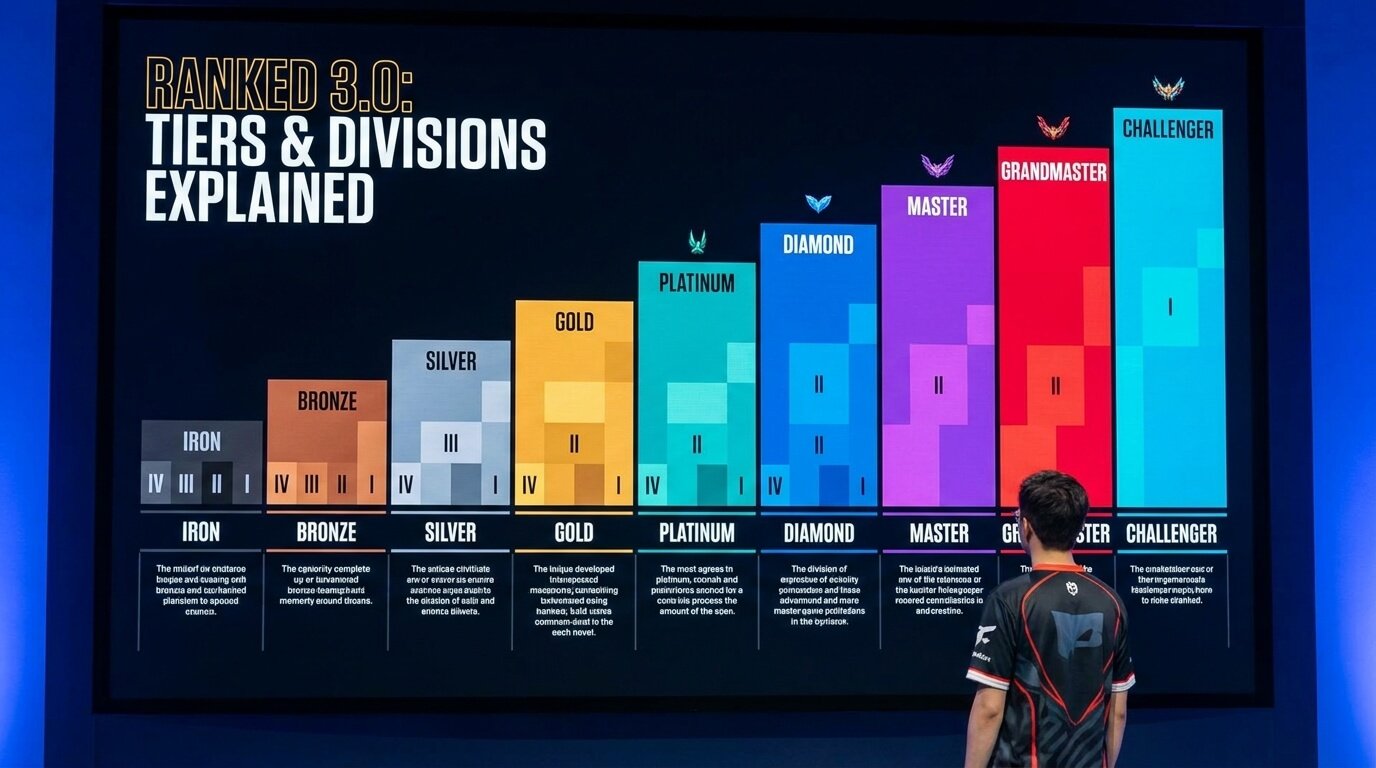
I still remember the exact night my old Diamond badge turned into something I didn’t recognize. I logged in expecting my usual lobby, and instead I was staring at a rank screen that looked nothing like the one I’d climbed for two years. No hidden number, no mystery meter quietly deciding my fate behind the scenes — just a straight ladder with a name and a division on it. That’s the short version of what changed. The long version is why understanding the R6 ranks in order actually matters now more than it ever did before.
For years, your visible rank in Rainbow Six Siege was basically a rough guess. A hidden Skill Rating sat underneath it, quietly running the show, and your badge would occasionally lag behind or jump ahead of what that number actually said about you. Ranked 3.0 tore that structure out. What replaced it is simpler, more transparent, and honestly a lot easier to explain to a friend who just downloaded the game. This guide walks through the full R6 ranks in order, how Rank Points move you between them, what actually changed with this overhaul, and where most of the player base is currently sitting.
The Full List of R6 Ranks in Order
Let’s start with the part everyone actually searches for. Here are the R6 ranks in order, from the very first tier a new account sees to the one displayed on pro leaderboards:
- Copper
- Bronze
- Silver
- Gold
- Platinum
- Emerald
- Diamond
- Champion
That’s eight tiers, and under Ranked 3.0 every single one of them — Champion included — is broken into five divisions, labeled V, IV, III, II, and I. Division V is always the entry point of a tier, and division I is the doorstep into the next tier up. Multiply eight tiers by five divisions and you get 40 distinct steps between a fresh account and the top of the ladder.
| Rank | Divisions | What You’ll Notice Here |
|---|---|---|
| Copper | V–I | Everyone lands here after a full reset |
| Bronze | V–I | The single most crowded tier in the game |
| Silver | V–I | Rotations and callouts start becoming consistent |
| Gold | V–I | The widest spread of skill in one tier |
| Platinum | V–I | Utility usage and trades get noticeably sharper |
| Emerald | V–I | The bridge tier between Platinum and Diamond |
| Diamond | V–I | A small, genuinely skilled slice of the population |
| Champion | V–I | Tracked on a live leaderboard, no ceiling on RP |
A detail that trips people up constantly: Emerald sits directly between Platinum and Diamond, not after Diamond. If someone tells you they “just missed Diamond and dropped into Emerald,” that’s the correct direction — Emerald is the step below Diamond, not above it. Keep that order in your head and the rest of the R6 ranks in order system falls into place quickly.
How Divisions and RP Actually Work
Once you know the order, the next question is how you actually move through it. Ranked 3.0 runs entirely on Rank Points, usually just called RP.
- Division size: Every division needs 100 RP before you’re promoted into the next one.
- Per-match swing: A typical win or loss shifts your RP total by roughly 80 points, though this isn’t fixed.
- Opponent strength matters: Beat a team that outranks you and you’ll earn noticeably more RP than usual. Lose to a team well below your rank and you’ll lose more than a typical match would cost you.
- The Demotion Shield: If your RP sits above zero within a division, this shield absorbs a single loss so it doesn’t knock you down a division. It’s not permanent protection — it just buys you a cushion after a promotion.
- Falling a division: Once you’re already sitting at 0 RP and the shield isn’t active, another loss drops you into the top of the previous division.
- Squad-based limits: This is new territory for a lot of veteran players. Copper through Emerald accounts can only party with teammates inside a three-rank window. Diamond and Champion players are held to a tighter two-rank window. Placement matches are the one exception — those games ignore the restriction entirely.
- Squad RP weighting: Even inside that allowed window, matchmaking still weighs your squad against your strongest teammate, not your average. Queuing with a much higher-rank friend won’t make your games easier or shield your RP.
There’s one myth worth killing outright: your kill/death ratio has zero influence on your rank. Ubisoft addressed this directly on a Community Checkpoint stream, confirming that RP is driven by match outcome and squad rank balance — not by how many frags you racked up along the way. I used to obsessively check my KDA after every match. I don’t anymore, because it simply isn’t part of the equation.
What Ranked 3.0 Actually Changed
If you played Siege years ago and stepped away, here’s the short list of what’s genuinely different now:
- Hidden MMR is gone. Your visible badge and your actual matchmaking strength are now the same thing.
- Champion got divisions. In older seasons, Champion was a single flat tier. Now it has the same five-division structure — V through I — as everything below it.
- Squad rank restrictions were introduced. Stacking a Copper account with a Diamond friend for an easy carry isn’t really viable anymore outside of placements.
- The reset is softer than it looks. Every season closes with a rank reset, followed by five placement matches to set your new starting point. Those placement games carry boosted RP swings, so a player who finished the previous season in Platinum tends to land back near Platinum, not back at Copper V.
- The Demotion Shield was added as a buffer. One rough loss right after a promotion won’t automatically send you backward.
I went through my own five placements the week this system launched, and my landing rank tracked closely with wherever I’d finished the season before. That matched what Ubisoft said the intent was — a soft recalibration, not a full wipe of your standing.
Climbing the R6 Ranks in Order Faster
Generic advice like “play as a team” gets repeated so often it stops meaning anything. Here’s what’s actually moved the needle for me and the people I regularly queue with:
- Own your crosshair placement. Pre-aim head height before you peek. Siege’s time-to-kill is short enough that reaction aim alone won’t save you against someone already lined up.
- Take placement matches seriously. Since these five games carry extra RP weight, running your most comfortable operators here — not experimental picks — pays off more than in a normal ranked match.
- Ease into a fresh reset. Lobbies right after a season reset tend to feel inconsistent because RP hasn’t settled across the population yet. A slower first week beats a frustrating grind session.
- Narrow your operator pool. Two or three attackers and two or three defenders, mastered properly, will outperform a rotating cast of ten operators you’re mediocre with.
- Play for the round, not the scoreboard. Trades, plant denial, information, and objective control move your RP. Kills alone don’t. Once I stopped chasing frags and started playing for round outcomes, my climb got noticeably smoother.
- Track your Competitive Rewards separately from rank. Wins earn 2 points and losses earn 1 toward this system, and every ten points unlocks a reward regardless of whether you’re climbing or stuck in a rut that week.
- Remember rank rewards lock in at your peak. Whatever your highest seasonal rank was is what determines your end-of-season cosmetics, even if you slide back down before the season ends.
Where Most Players Actually Sit on the Ladder
Ubisoft hasn’t published a fully confirmed distribution table for Ranked 3.0 yet, so treat any specific percentage as a snapshot rather than gospel. That said, the patterns so far are pretty consistent with what long-time players would expect.
| Trend | What It Tells You |
|---|---|
| Bronze concentration | Bronze V and Bronze IV alone account for over 6% of tracked accounts each |
| Overall Bronze share | Roughly a quarter of the ranked population sits somewhere in Bronze |
| Upper-ladder clustering | Ubisoft has acknowledged more players landing higher than intended early on |
| Placement weighting | Future seasons are expected to lean more heavily on placement results |
| The Gold-to-Platinum wall | This remains the point where a lot of climbs stall out |
| Diamond and Champion | Still a genuinely small slice, well above the average account |
Ubisoft has been fairly upfront about the clustering issue, confirming during a Community Checkpoint that early placements pushed an unusually large share of players into tiers like Emerald, and that placement matches will likely carry even more influence over starting rank in upcoming seasons to spread that distribution back out.
I hit Emerald for the first time shortly after this system rolled out, and it genuinely didn’t feel like some minor stopover tier. The population numbers back that impression up — it’s a smaller group than the badge alone would suggest.
What’s Coming After Champion: The Legend Division
Champion isn’t the final stop anymore. Ubisoft has confirmed a new tier sitting above it called the Legend Division, expected to take over from the current Champion leaderboard starting in Season 3.
The requirements Ubisoft has laid out so far are specific: reach Platinum or higher during Season 2, hit Champion again in Season 3, and have the R6 ShieldGuard Secure Platform active alongside app-based two-factor authentication on your account. In other words, this isn’t just a skill gate — account security is baked into eligibility too.
These conditions could still shift before launch, so treat them as the current outline rather than a locked-in rulebook. Ubisoft has said more details will land closer to the Legend Division’s actual release.
Frequently Asked Questions
What’s the highest rank in Rainbow Six Siege right now? Champion I sits at the very top of the current R6 ranks in order, above Champion II through V. It’s the tier tracked on the game’s live competitive leaderboard, at least until the Legend Division takes over that role.
How many total ranks exist under Ranked 3.0? Forty. Eight tiers — Copper through Champion — each broken into five divisions running from V up to I.
Does my rank fully reset every season? It’s a soft reset, not a wipe. Your five placement matches factor in how you performed the previous season, so a strong finish tends to translate into a strong starting point rather than a grind back up from Copper V.
If I derank before the season ends, do I lose my rewards? No. Cosmetic rewards tied to rank — things like your seasonal charm or card background — are locked in based on the highest rank you reached that season, even if you slide back down afterward.
Final Thoughts
Knowing the R6 ranks in order used to be a bit of trivia. Now, with hidden MMR gone and every tier running on the same visible RP system, that order is basically a roadmap of your account’s actual progress. Learn the eight tiers, respect what the Demotion Shield does and doesn’t protect you from, take your placement matches seriously, and keep your operator pool tight. The ladder is longer than it used to be with 40 total steps, but it’s also a lot more honest about where you actually stand — and that’s a trade most of the community seems glad to have made.
Leave a Reply