

You’re scared of losing money. Good. That fear is going to protect you.
Most people don’t lose money in crypto because it’s crazy. They lose money because they skip a plan and buy on impulse.
This guide is that plan. Nothing fancy. Nothing that requires you to watch charts all day.
We’ll cover what to actually buy, how much, and how to avoid the mistakes that wipe out beginners in month one.
The Real Reason Beginners Lose Money
It’s rarely the market crashing. Markets go up and down. That’s normal.
It’s almost always one of three things: buying a hyped coin, investing money they needed, or panic-selling at the worst moment.
Fix those three things, and you’re already ahead of most people who jump into crypto.
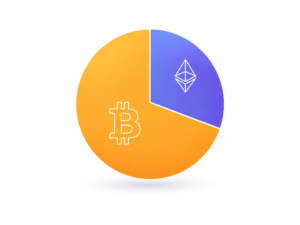
Start With the 70/30 Rule
Here’s a simple framework to anchor your first portfolio: put 70% into Bitcoin and 30% into Ethereum.
This isn’t a magic formula. It’s a risk-reduction habit, not a guarantee of returns.
Bitcoin gets 70% because it’s the most established, most liquid, and least likely to disappear overnight. It behaves more like digital gold than a startup bet.
Ethereum gets 30% because it powers a huge share of the apps and tools built on crypto. It carries more upside, and more risk, than Bitcoin.
That’s it. Two assets. No spreadsheet of forty coins to track.
Why only two? Because every extra coin you add is another thing that can go to zero. Beginners don’t need more choices. They need fewer.
Why You Should Skip Meme Coins Completely
You’ve probably seen the screenshots. Someone put in $200 and now has $40,000.
What you don’t see are the thousands of people who bought the same coin and lost everything.
Meme coins have no underlying product. Their price moves on hype, influencer posts, and momentum. Nothing else is holding the price up.
When the hype fades, and it always does, there’s no floor. The price can go to zero in hours, not weeks.
If you want to gamble $20 for fun, that’s your choice. Just never call it “investing.” And never put in money you’d miss.
Remember Dogecoin in May 2021? Elon Musk hosted Saturday Night Live and called it “a hustle” on air. The price dropped over 30% within hours. People who bought the hype the week before watched their money vanish in a single weekend. Nothing about the coin changed. The hype just moved on.
How Much Should You Actually Invest?
Only invest money you could lose completely and still pay rent, still eat, still sleep at night.
A simple gut check: if this money disappeared tomorrow, would your life change? If yes, it’s too much.
Most beginners start with a small amount, sometimes $50 to $200. That’s enough to learn the process without real damage.
You can always add more later. You can never un-lose money you needed.
Use Dollar-Cost Averaging, Not Timing
Trying to “buy the dip” is how experienced traders lose money. Beginners have almost no chance.
Dollar-cost averaging (DCA) means buying a fixed amount on a schedule. Weekly or monthly, no matter the price.
Some weeks you’ll buy high. Some weeks you’ll buy low. Over time, it evens out.
This one habit removes the panic-decision problem entirely. You’re not guessing. You’re following a plan.
Where to Buy: Pick One Platform and Verify It
Choose an exchange that’s regulated, available in your state, and has a real security track record.
Complete identity verification (KYC) when asked. That’s a legal requirement, not a red flag.
Red flags to watch for: platforms with no verification step, no phone support, or guarantees of fixed daily returns. Walk away from all three.
The Part Everyone Skips: Where You Store It
Buying crypto is step one. Storing it safely is the step that actually protects your money.
If your exchange gets hacked or freezes withdrawals, coins left there can be gone. This has happened before, to real people.
This isn’t theoretical. In November 2022, FTX, one of the world’s biggest exchanges, froze withdrawals overnight. Customers couldn’t touch their own money. Billions of dollars vanished, and years later, people are still fighting to get partial refunds. Mt. Gox did the same thing back in 2014, losing hundreds of thousands of customer bitcoins. Both times, the lesson was identical: if you don’t hold your keys, you’re trusting a company with your money.
For small starter amounts, keeping coins on a reputable exchange while you learn is fine. Once your balance matters to you, move it.
A hardware wallet keeps your coins offline, away from hackers. Devices like Ledger or Trezor are the standard choice.
Whatever you do, never share your seed phrase. Not with support staff, not with an app, not with anyone. Ever.
Write it on paper. Store it somewhere safe. That’s it. No photos, no cloud notes.
Five Mistakes That Wreck Beginners
Watch for these. Each one has ended someone’s first year in crypto.
- Buying because a coin is “up 500% this week” — you’re buying the hype, not the asset
- Putting in rent or emergency fund money — never invest what you need soon
- Sharing a seed phrase with “support” — no legitimate company will ever ask for this
- Panic-selling during a normal price drop — drops are part of the process, not a signal to run
- Spreading money across 15 coins — more coins usually means more risk, not more safety
A Simple First-Month Checklist
- Pick one regulated exchange and complete verification.
- Decide your total amount — money you can afford to lose fully.
- Split it 70% Bitcoin, 30% Ethereum.
- Set a weekly or monthly DCA schedule.
- Move meaningful balances to a wallet you control.
- Write your seed phrase on paper. Store it safely.
- Ignore meme coin hype. Every time.
The Honest Bottom Line
There’s no strategy that guarantees profit. Anyone promising that is lying to you.
What this framework does is remove the decisions that hurt beginners most: chasing hype, overinvesting, and panicking.
Start small. Stick to Bitcoin and Ethereum. Protect your keys. Give it time.
That’s not exciting advice. It’s the advice that actually works.
This article is for educational purposes and isn’t personalized financial advice. Cryptocurrency is volatile and carries real risk of loss — only invest what you can afford to lose, and consider speaking with a licensed financial advisor about your specific situation.
Read More: https://mygamerankgamesguides.com/
Leave a Reply