
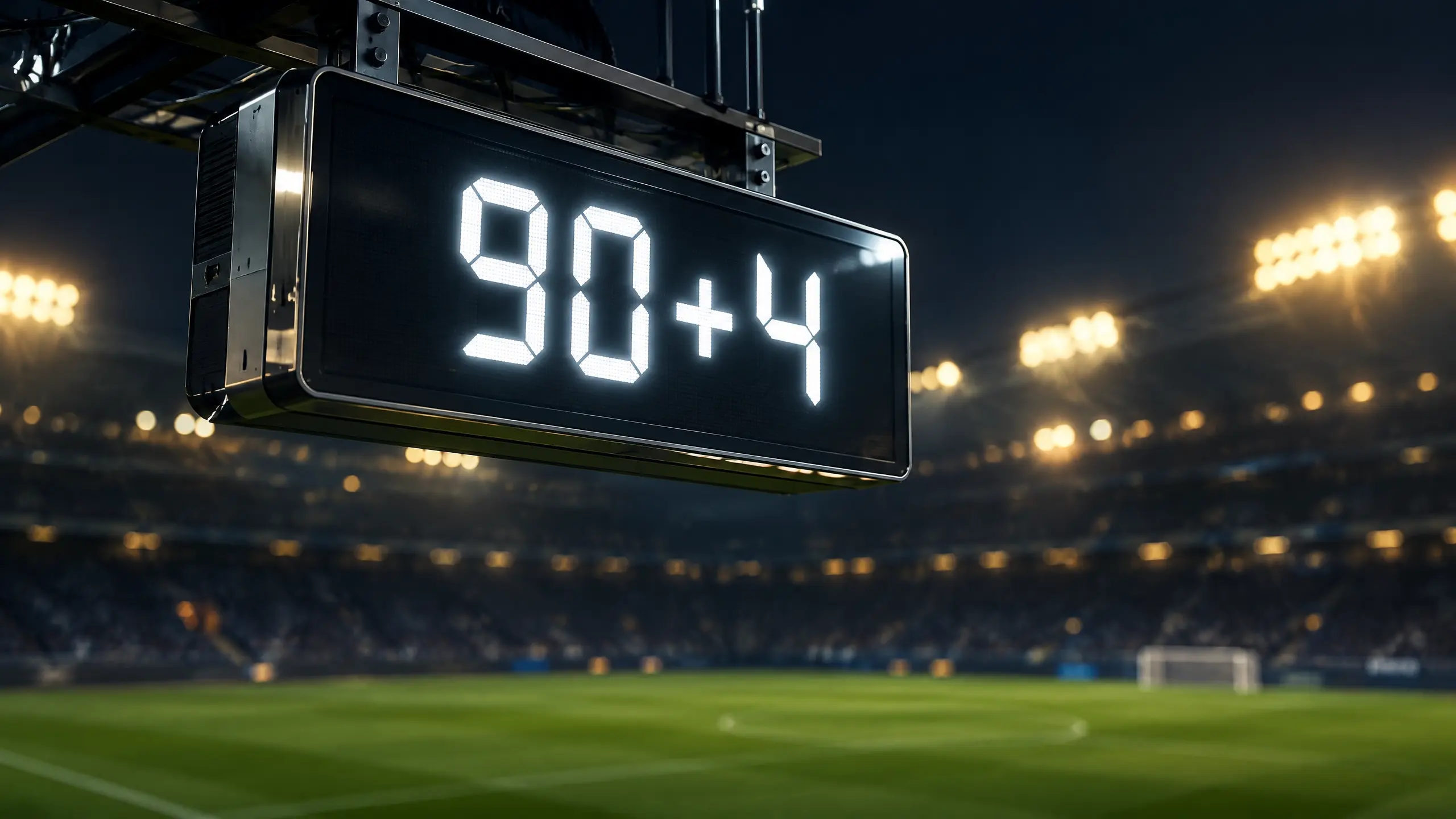
You sit down to watch a soccer game. The clock says 90 minutes. Simple, right?
Then minute 90 comes and goes. The players keep playing. Nobody stops them.
That’s not a glitch. That’s just how soccer works. Here’s exactly what you’re watching, and why the clock never seems to end when you expect it to.
The Baseline: 90 Minutes, Two Halves
A standard soccer game runs 90 minutes, split into two 45-minute halves.
Between halves, there’s a 15-minute halftime. Players head to the locker room and come back out.
This structure comes straight from Law 7 of the IFAB Laws of the Game — the rulebook that governs professional soccer worldwide, men’s and women’s alike.
But 90 minutes is the starting point, not the finish line. Almost no game actually ends right on the dot.
Look at England vs. Iran at the 2022 World Cup. The scheduled 90 minutes turned into 117 minutes and 16 seconds. Why? A first-half concussion to Iran’s goalkeeper, plus a flood of substitutions and stoppages. The referee added 14 minutes to the first half alone. Fans expecting a quick two-hour outing got something closer to a made-for-TV movie.
Why the Clock Never Actually Stops
Here’s the part that trips up new fans the most: soccer’s clock runs continuously. It doesn’t pause for anything.
Football and basketball freeze the clock constantly. Soccer doesn’t do that. Ever.
So every injury, goal celebration, or slow substitution eats into real playing time, and the clock just keeps climbing through it.
To make up for that, referees add stoppage time at the end of each half. Broadcasters also call it added time or injury time.
The current text of Law 7 spells out exactly what qualifies: substitutions, injury treatment, time-wasting, disciplinary cards, medical breaks, and explicitly, “delays relating to VAR checks and reviews.”
That VAR line is a fairly recent addition, and it’s a big reason stoppage time feels longer than it used to. The visible turning point was the 2022 World Cup in Qatar, when FIFA publicly instructed referees to add more time for goal celebrations and stoppages. Added time of 7 to 10 minutes per half, once rare, became common.
Before that shift, referees mostly estimated added time loosely, often defaulting to a flat “3 minutes.” Now they’re expected to track actual seconds lost, VAR reviews included, which is why the numbers have crept upward. If you want to check the current wording yourself, the Law 7 page above lists it verbatim.
The result: what used to be a routine 2-to-3-minute addition can now run 5 minutes or more, especially in games with a VAR review or a red card.
So a “90-minute” match typically finishes closer to 95 to 100 minutes of actual clock time.
When 90 Minutes Isn’t Enough to Decide a Winner
Regular-season games can end in a tie. Nobody sweats it. Everyone goes home.
Knockout games are different. Someone has to win — think World Cup elimination rounds or a cup final.
If the score’s level after 90 minutes plus stoppage, the match moves into extra time: two more 15-minute halves.
Still level after that? A penalty shootout decides it. Five kicks each, sudden death after that if needed.
The 1966 World Cup Final is the textbook case. England and West Germany were tied 2-2 after 90 minutes at Wembley. Neither side could find a winner, so the match went to extra time. Geoff Hurst scored twice more in those extra 30 minutes, finishing with a hat-trick, and England won 4-2. Without extra time, that final never gets decided that day, and soccer history looks a little different.
Stack regulation, stoppage, extra time, and a shootout on top of each other, and a single knockout match can run past three hours from kickoff to final whistle.
The Big Mistake New Fans Make
Most people treat “90 minutes” as a fixed, reliable stop time. That assumption causes real problems.
Maybe you schedule a pickup or an appointment right at the 90-minute mark. The game’s still going. Now you’re either late or you’re missing the ending.
Or you leave a few minutes early, figuring stoppage time is just a formality. Then the winning goal happens in minute 94, and you find out about it on your phone.
The fix is simple: treat 90 minutes as a floor, not a ceiling. Assume the game will run at least 5 to 10 minutes past regulation before you commit to anything scheduled right after.
For knockout games, assume there’s a real chance it goes even longer, and plan around that instead of hoping for the best.
Youth and High School Games Play by Different Clocks
If you’re watching a kid’s game, the 90-minute number doesn’t apply at all. Youth and school soccer scale the clock down by age.
The exact numbers vary by league, so check with your specific organization. But the general shape, based on guidelines from US Youth Soccer and the NFHS, looks like this:
| Level | Typical Format | Approx. Total Time |
|---|---|---|
| Under 8 | Short quarters (~12 min each) | 40–50 min |
| Under 12 | Two halves (~25–30 min each) | 55–65 min |
| Middle school | Two 30-minute halves | ~65 min |
| High school | Two 40-minute halves | ~90 min |
| U17 and up | Full adult format | 90 min |
Younger age groups also get shorter halftimes, often 5 to 10 minutes instead of the full 15.
How Much Time to Actually Block Off
If you’re the one showing up to watch, here’s a realistic total, door to door:
- Youth games: 45 minutes to 1.5 hours
- High school games: roughly 1.5 to 2 hours, halftime included
- Pro or college regulation games: about 2 hours
- Knockout matches that could go long: up to 3 hours
That gap between the “90 minutes” you hear about and the 2 hours you actually spend is stoppage time, halftime, and warmups, not a mistake in your math.
The One Thing Worth Remembering
Soccer’s clock counts up, and it doesn’t stop for the small stuff, VAR checks included.
That’s exactly why “90 minutes” always stretches into something longer. It’s built into the sport, not a flaw in it.
Once that clicks, the added-time board stops being confusing. You’ll know exactly what those extra minutes mean, and you won’t get caught off guard by them again.
Read More: https://mygamerankgamesguides.com/
Leave a Reply